

Like a navigator reading the stars to chart a course across the open ocean, analysts use the Bảng xếp hạng fifa to determine the relative strength of nations before major tournaments. Understanding these metrics is essential for anyone tracking kết quả bóng đá across different continents and leagues. This system provides a mathematical backbone to the subjective debates that often dominate sports bars and newsrooms. By quantifying success over a four-year cycle, the ranking offers a definitive glance at who is currently leading the global pack.
Beyond the headline position, analysts can examine factors such as recent results, competitive context, and the strength of opponents faced. A team’s ranking may therefore change as new matches are recorded, making regular updates important when assessing international form. Comparing ranking movements over time also provides useful context for understanding how consistent performances, tournament results, and periods of rebuilding can influence a national team’s position.
How the Elo System Refines the FIFA World Rankings Accuracy
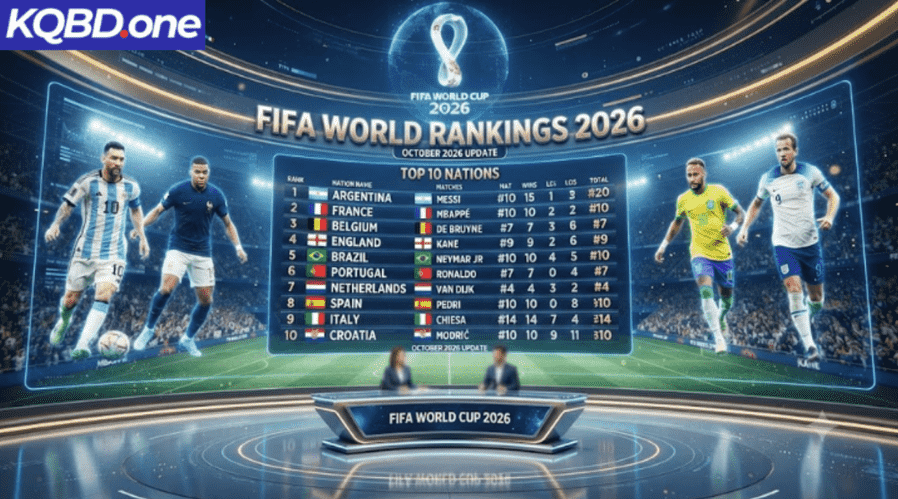
One thing very few actually pay attention to is the transition from a simple averaging model to the sophisticated Elo calculation method. This change was implemented to ensure that every match played has a proportional impact on a team’s total points based on the difficulty of the opponent. For instance, defeating a top-ten nation yields significantly more points than a victory over a team outside the top one hundred. This ensures the Bảng xếp hạng fifareflects current form rather than historical reputation alone.
Beyond that, the system accounts for the importance of the match type. Friendly matches carry the least weight, while World Cup finals matches offer the highest coefficient for point accumulation. This nuanced approach prevents teams from inflating their positions by playing exclusively weak opponents in non-competitive windows. For those who track these movements closely, the data reveals which nations are truly overachieving relative to their resources.
Another important factor is the margin and outcome of each contest, which can influence how efficiently ranking points are adjusted. Unexpected victories against highly rated opponents may produce notable movement, while losses to lower-ranked sides can have a greater effect. Monitoring these changes after each international window helps analysts identify emerging trends and understand shifts in competitive balance.
Strategic Impact of Regional Coefficients on Continental Standings
A significant portion of the ranking’s complexity comes from the weight assigned to different confederations. While the mathematical formula is standardized, the strength of the opposition often depends on the regional ecosystem, such as UEFA or CONMEBOL. The Bảng xếp hạng fifa serves as a vital tool for seeding during tournament draws, which can fundamentally alter a nation’s path to a trophy. Notably, being placed in Pot 1 versus Pot 2 can be the difference between an easy group stage and a “Group of Death.”
In addition, these rankings influence the commercial value of national teams. Sponsors and broadcasters often look at these positions to determine the marketability of upcoming fixtures. Another key aspect is how smaller nations use these rankings to measure the success of their long-term development programs. When a team climbs fifty spots over two years, it is usually a sign of structural improvement in their domestic coaching and youth academies.
These movements can also provide a broader reference point when comparing teams from different competitive environments. Analysts may examine ranking changes alongside tournament performances, player development, and coaching continuity to identify longer-term patterns. For emerging football nations, steady progress in the rankings can offer measurable evidence of improved results while highlighting areas that still require further investment and development.
The Role of Consistent Match Cycles in Maintaining High Positions
Maintaining a high spot requires more than just occasional brilliance; it demands a relentless consistency across all international breaks. Teams that fail to schedule high-quality friendlies or those who rotate their squads too heavily in competitive qualifiers often see a sharp decline. One thing very few actually pay attention to is how a single draw against a much lower-ranked opponent can erase the gains of three previous victories. This creates a high-stakes environment for every international window.
High-frequency updates allow for real-time tracking of team momentum.
Weighting factors ensure that competitive matches define a team’s true ceiling.
Point deductions for losses prevent stagnant teams from camping at the top of the list.
The system incentivizes nations to play against diverse opponents outside their home continent.
For those who analyze these shifts, the data acts as a pulse check for the sport’s health. When emerging nations from Asia or Africa break into the top twenty, it signals a broadening of the talent pool. This global parity is exactly what the ranking system aims to highlight by providing a neutral, data-driven perspective on performance.
Navigating the Future of Global Football Metrics

The shift toward deep-level statistical modeling has made these standings more transparent and easier to scrutinize than in previous decades. Fans can now use online calculators to predict how a specific win or loss will impact their nation’s standing in the next update. This level of engagement has turned a dry list of numbers into a source of national pride and intense debate. As the game evolves, the metrics used to define “the best” will likely continue to incorporate even more granular data points.
Notably, the integration of advanced analytics into the ranking discussion helps explain why certain teams remain dominant. It is not just about the final score, but the consistency of performance against elite competition over a sustained period. The Bảng xếp hạng fifa remains the primary benchmark for this excellence, serving as the ultimate scoreboard for the international game. Whether it is used for seeding, scouting, or simple bragging rights, its influence on the footballing landscape is undeniable.
Conclusion
As the next major tournament cycle approaches, the fluctuations in these standings will dictate the narratives of the sport. Teams on the rise will look to solidify their status, while traditional giants will fight to reclaim their former glory. This fluid environment ensures that the international football scene remains a high-energy and constantly shifting theater for millions of viewers worldwide. Tracking the Bảng xếp hạng fifa is the most reliable way to stay informed about these shifts and understand the true hierarchy of the world’s most popular sport. Explore today.
